7/09/2016

Bike Trip! French Prairie and Champoeg Historical Route

Site of the Vote for Oregon's First Provisional Government


Champoeg is an important historical site located just south of the Portland metro area. Some of the earliest Euro-Americans to inhabit the area, known as the "French Prairie," were French Canadian fur trappers with the Hudson's Bay Company. Throughout the 1820s and 1830s Hudson's Bay Company influenced politics and social life on the French Prairie.


Dr. John McLoughlin, often referred to as the "Father of Oregon," induced many former Hudson's Bay Company employees to settle the area in the 1830s. A growing number of American pioneers were also settling on the land. A series of meetings began in 1841 to discuss the formation of a government. The meetings went on in the town of Champoeg for three years until May 2, 1843 when frontiersman Joe Meek called for a final vote.  Meek drew a line in the dirt with the heel of his boot and asked all who favored the organization of a provisional government to stand with him on one side and all who opposed to stand on the other. Fifty two of them stood with Meek and 50 did not, although the actual counts are disputed.

A frontiersman named Dr. "Doc" Robert Newell stood along with Meek in support of the provisional government, which subsequently selected Newell as Speaker. Newell arrived in the area in 1840, and in the year before the vote (1844), acquired a 640 acre donation land claim. Newell promoted the location for the townsite and was instrumental in the establishment of Champoeg.

Inception of Birth of Oregon, Theodore Gégoux, 1923
Oregon State Parks and Recreation Department : State Archives Holdings

After this historical vote, the town persisted as a shipping point for river transportation. Wheat was the primary crop of the farms on French Prairie and was transported to market down the river on steamboats; railways had not yet arrived. An 1851 sketch of the townsite shows how undeveloped it was at this time. The platted town of Champoeg was recorded in 1852 and grew rapidly. However, in December 1861 an incredible flood swept through the town.

Markers in the location of the former townsite that display the
water level from the recent 1996 flood compared with the 1861 flood
Champoeg State Park

Nothing remained. Champoeg continued to serve as a shipping point for the valley, and several new buildings were constructed. But another flood destroyed the town again in 1892, ending further attempts to use the site for a settlement.

Today, the townsite is located within the Champoeg State Park and can be experienced by bike. Champoeg State Park marks the northern point of the Willamette Scenic Bikeway and the historic townsite of Champoeg can be experienced by bike within the park itself. A basic map is shown below and a more detailed version is provided by Friends of Historic Champoeg.


We started our day at the Newell House Museum. Admission was $6 for adults and allowed us to explore the historic Newell house as well as the Butteville school and jail.

Doctor Robert Newell ("Doc" Newell) was born in 1807 in Ohio and came to Oregon by way of St. Louis where he worked as a saddle maker. At age 22, he began a career as a fur trapper along with partner, Joe Meek, and when beaver became scarce in the late 1830s, Newell decided to settle on the French Prairie in 1840 along with his wife, Kitty, a daughter of a sub-chief of the Nez Perce tribe. While he did not have medical training, he became skilled in performing basic surgical procedures and was referred to as "doc" from that time on.

Newell brought his provisions to the Willamette Valley, blazing the first wagon trail into Oregon along with Joe Meek. He first established his residence on the Tualatin Plains (now Hillsboro) but desired to be near a navigable river and so moved to the site of Champoeg where he accepted a donation land claim. In 1843, the mass meeting was held, as described above, to vote on a provisional government. Newell was a member of the Legislative Committee and helped frame the law that was adopted that July.

His wife, Kitty, passed away in 1845 and he remarried to Rebecca Newman in 1846. In 1849, Newell decided to travel to California and search for gold. While there's no record of a large stake, he returned in 1850 and built his home in 1852 taking up warehousing and operating a commission business in wheat.  Newell was instrumental in platting Champoeg.


At its height, the population was around 200 people, with stores, blacksmiths, livery stables, churches, saloons, a hotel, a school, and other services. Markers in Champoeg State Park display the locations of Champoeg streets.


On December 2, 1861, the Willamette River rose 55 feet above its normal summer stage, flooding the town with seven feet of water. The flood washed away everything including Newell's warehouse and store and covered the entire town. Newell's home, however, stood high above the water and a large number of the townspeople took refuge there. He nearly went bankrupt caring for the townspeople after the devastating event.

Newell House

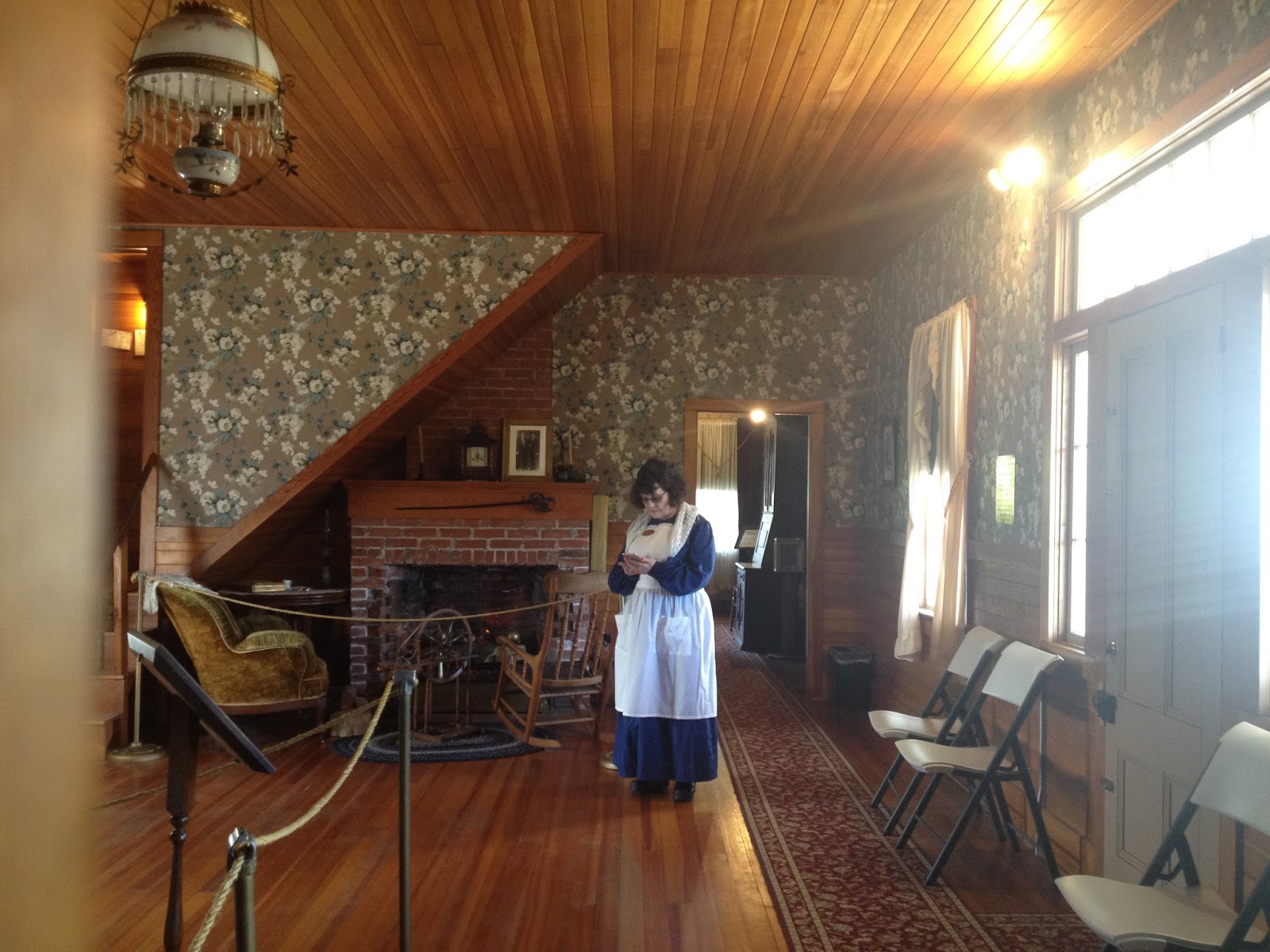
Inside the Robert Newell House
The house was restored in 1952 by the Daughters of the American Revolution (DAR). The tour of the house is fascinating and gowns worn by the wives of Oregon’s Governors are displayed upstairs. There is also a display of Native American handcrafts and historical photos and news articles about the Newell as well as quilts, spinning equipment, and looms. There's lots to see.


There are a couple of other historical structures next to the Newell house museum, including the relocated Butteville jail (1848) and two-room schoolhouse (1859). These structures were relocated by the DAR in the late 1950s. You can continue riding from the Champoeg townsite to Butteville along the Champoeg bike trail, which parallels the Willamette River.


There are four miles of trails within the park. If you decide to ride to Butteville, you can see the historic Butteville store, which is more than 149 years old and the longest continually active store in Oregon.


Butteville is one of Oregon's earliest towns and was used as a river landing. It was an arch rival to Champoeg competing for shipping services needed by French Prairie farmers. It survived the devastating flood of 1861. West of the store is a mid-19th century mansion built by a prosperous grain merchant. The main traffic was by steamer in those times, so the front door faces the river. A ferry operated from Butteville in 1853. It was a thriving port until the railroad arrived.

From "A History of Oregon Ferries since 1826"
There's so much to see and so much history in this area, it's a great way to spend a day. There is also nearby St. Paul, which I'll cover in a separate post.

2/21/2016

Southeastern Arizona

I love living in Oregon. But, not being a native Oregonian, I do get burned out on the rain by February. We usually try to take a trip to some place warm and sunny around this time of the year to lift our spirits and get some Vitamin D!  This year we decided to tour southeastern Arizona. I don't think we were alone, though, because we overheard quite a few tourists saying they were from Oregon as well.

Our route started in Phoenix. We headed east to Superior then south to Hayden and Dudleyville where we picked through some nearby mine tailings for wulfenite and calcite. No luck. We camped at the Dudleyville site.


Camping near Dudleyville

The next day we traveled on to Tucson, stopping at the 'famous' El Charro Café for lunch. Established in 1922, El Charro Café of Tucson, Arizona is The Nation's Oldest Mexican Restaurant in continuous operation by the same family. While there, we caught a glimpse of the old Presidio San Augustin del Tucson, which has been reconstructed. We found it mildly interesting and didn't spend much time there. We headed south to the Fairbank Historic Town Site, which is located within the San Pedro Riparian National Conservation Area. Like nearby Tombstone, Fairbank was a silver mining area. It was also the closest train depot to nearby Tombstone, another mining town. There isn't much left of it today, but there is a trail head in the town that takes you on a loop along the San Pedro River with stops at old mining structures and the town cemetery.

Fairbank Cemetery
Fairbank Historic Town Site

We were hoping to get a number of bird sightings during the hike, but there wasn't much to be seen. Some of the birds we saw throughout the entire trip include:

Teddy Bear Cholla
Restored Bisbee Gas Station
  • Rufous-crowned Sparrow
  • White Breasted Nuthatch
  • Common Raven
  • American Kestrel
  • Roadrunner
  • Acorn Woodpecker
  • Dark-eyed Junco
  • Red-naped Sapsucker
  • Mexican Jay
  • House Finch
  • Chipping Sparrow
  • Mourning Dove
  • Turkey Vulture
  • Crested Caracara
  • Gamble's Quail
  • Ash-throated Flycatcher
  • Abert's Towhee
  • Curve-billed Thrasher
  • Gila Woodpecker
  • Black-throated Sparrow
  • Crow
  • Loggerhead Shrike
  • White-crowned Sparrow
  • Yellow-rumped Warbler
  • Green Towhee
  • Red-tailed Hawk
  • Phainopepla
  • Harris' Hawk
  • Bridled Titmouse
  • Cactus Wren
  • American Coot
  • Cinnamon Teal
  • Grackle
We continued on to Tombstone, a former mining town established in 1879. It is known for its gunslingers, miners, and outlaws. It is the site of the legendary gunfight at the O.K. Corral. The town was founded by prospector, Ed Schieffelin, who ventured out from Camp Huachuca, looking for silver. Others within the camp warned him that the only stone he would find out in the dangerous Apache territory was his own tombstone. He did fine silver and named the mine "The Tombstone."

In 1879, Phillip Smith purchased the first pioneer store in Tombstone and erected the Cochise County Bank building at the site when the county was established. Several other businesses were located in the building after Smith went bankrupt. Today it is the visitor center.

Former Cochise County Bank

The historic district in Tombstone is on Allen Street. The most famous event in the town was the fight at O.K. Corral, which actually happened on Fremont Street. The fight involved the Earp brothers (Virgil, Wyatt, Morgan and Warren) who had conflicts with a band of outlaws known as The Cowboys. The conflicts escalated into a shootout in 1881 when the Earp lawmen killed Tom McLaury, Frank McLaury, and Billy Clanton of The Cowboys.

The Cochise County Courthouse was built in Tombstone in 1882 and operated until 1929 when the county seat was moved to Bisbee. It is now operated as a museum.

Old Cochise County Courthouse in Tombstone
Allen Street Historical District

After Tombstone, we headed to Bisbee, which is the location of the former Copper Queen Mine. The mine is what led to the growth of Bisbee. It was bought by Phelps Dodge in 1885 and closed in 1985. The Bisbee Mining and Historical Museum has incredible mineral specimens that were extracted from the mine. The building was formerly the Phelps Dodge General Office Building. Because of the mine, Bisbee was a boomtown, which is evident from the architecture.

Bisbee Mining and Historical Museum
Copper Queen Mine pit
Bisbee commercial district
Our trip was, in part, to do bird watching and rock hounding. In the hope of finding some birds, we traveled northward to the Chiricahua National Monument which is named after a band of Apache Native Americans. The monument has large areas of volcanic rock, which has eroded into pinnacles and spires. We camped on the edge of the park that night hoping to look for birds the next morning. We were really disappointed to find that most of the roads were closed.

We traveled west the next day to the Organ Pipe Cactus National Monument. This desert covers 120,000 square miles and is the most diverse desert in North America. There are several hikes and interpretive drives. Maps are available at the park headquarters.


The most distinctive cacti are the saguaros. The saguaro is the tallest and largest cactus in the United States growing as high as 50 feet and weighing several tons. It can live to be 200 years old. Other cacti include the prickly pear, teddy bear cholla, chain fruit cholla, and (although not a true cactus), the ocotillo. There are many more desert-adapted species to see and the landscape is incredibly beautiful.

Our final stop on the way to Phoenix was a mine company town called Ajo, north of the Organ Pipe Cactus National Monument on Highway 85. Ajo was designed for the New Cornelia mine workers in 1914 by founder John Campbell Greenway. Phelps Dodge acquired the mine and most of the town in 1931, eventually marketing the homes to snowbirds in 1986 after the mine closed. There is a visitor center in the old train depot which provides a mildly interesting walking tour. Most of the town is built in Spanish Colonial Revival style.

Curley School in Ajo built in 1919
Overall, it was an interesting trip with beautiful landscapes and some interesting historical sites. We could have picked a better time for birds, but we still saw quite a few and added some new species to the list. Overall, a nice winter getaway.


6/26/2015

Silver City, Idaho

Silver City, Idaho -- A Historical Mining Town

While returning from a rafting trip in northwestern Colorado, we stumbled upon a small ghost town called Silver City, just 50 miles south of Nampa. Silver City originally had its heydey in the 1880s as a gold and silver mining town, and it is still quite intact. In fact, there are many residents who spend the summers there until the road closes for the winter. Some of them are descendants of the original settlers.

Located in the Owyhee Mountains, the town was established in 1864 soon after silver was discovered at nearby War Eagle Mountain. War Eagle mountain is located to the east, and Florida mountain to the west. Both are about 8,000 feet in elevation. It was said that from the summit of War Eagle mountain, on a clear summer's morning, with the aid of a telescope one could see the Teton range in Wyoming and the Wasatch range in Utah.

The Idaho Bureau of Mines and Geology, estimated that $30,000,000 in silver/gold ore was mined from areas around Silver City between 1865 and 1914. Mining was intensive in the area until the failure of the Bank of California in 1875, which stopped most of the work.  One Poorman Mine ore specimen of  proustite ("Ruby Silver") from War Eagle Mountain was so spectacular, it was displayed in Congress and in the Paris International Exposition, where the exhibit received a special gold medal in 1867.

Poorman Mill on War Eagle Mountain from
"A Historical Descriptive and Commercial Directory of Owyhee 
County, Idaho" January 1898

By 1898, the Silver City population was nearly 2,000 people. The town once had hundreds of buildings including eight saloons, six general stores. Having the first telegraph service and first daily newspaper (The Idaho Avalanche and later The Owyhee Avalanche) in the Idaho Territory, Silver City also had a post office, hospital, and was the County seat until 1935. There are still about 75 buildings that remain.


One of the largest buildings we noticed was the old Idaho Hotel built by J.K. Eastman and Hosea B. Eastman in 1866. The owners enlarged the structure over time, adding a bar and porch in 1871 and a woodshed, kitchen and additional rooms in 1873. The hotel was sold several times between 1889 and 1898. It reopened for business in 1970 when it was purchased by Ed Jaegels.

Idaho Hotel

The Masonic Hall was another distinctive building located on Morning Star Street. It was originally owned by Tom Jones and used as a planing mill used to produce lumber for homes and other structures. It was purchased in the mid-1870s by the Masonic Lodge. 

Masonic Hall

Another distinctive building we noticed was an Odd Fellows Lodge built in the 1870s. Originally an apartment house, one of the early owners was Dave Adams who rented out apartments while operating the adjacent general store. The telephone office was located here from 1901 to 1905. It was eventually purchased by the I.O.O.F. and Knights of Pythias who shared the rooms. The Knights of Pythias turned the lower floor into a dance hall and stage for an orchestra. The I.O.O.F. eventually obtained full ownership of the building.

I.O.O.F  Hall

The Meat Market Shop had several owners, the last known operator being Clyde Stoltz. Supposedly, there are still meat racks, hooks and other fixtures inside. A large walk-in box was constructed to provide refrigeration before the days of electricity. Ice was placed in a compartment above the box and under the shop buried in sawdust. Cattle were driven to town from nearby ranches. In the early days, it was discovered that the local bunch grass and white sage produced excellent cattle, and many local ranches were established. In 1898, it was estimated that there were 60,000 head of cattle in Owyhee County (A Historical, Descriptive, and Commercial Directory of Owyhee County, press of the Owyhee Avalanche 1898).

Butcher Shop

On the north side of town off Morning Star Street is the Idaho Standard School, which opened in 1892 and was used until 1934. It was supposedly built from tax revenue from the saloons. It has been restored and now houses a museum of Owyhee County and Silver City memorabilia.

Idaho Standard School

There are several other buildings to explore in this old town, such as the town's last post office location built around 1868 as a residence and discontinued in 1943 during World War II. There is also a brewery vat built by Will Hawes, who lived in Silver City his entire life. He built the vat and added a miniature bar scene inside, which has since been destroyed. If you visit, keep in mind that the buildings are private property and should not be entered unless they are an operating business open to the public.

6/20/2015

Yampa River - Deerlodge Park to Split Mountain

Whitewater Rafting on the Yampa River - Deerlodge Park to Split Mountain

With no major dams and diversions, the Yampa River is considered one of the last wild rivers in the West. It is the longest free-flowing tributary in the Colorado River basin and the largest tributary to the Green River. Its headwaters begin in the White River National Forest of northeastern Garfield County, Colorado. It is joined by the Little Snake River before entering Dinosaur National Monument and ultimately joins the Green River in Echo Park in extreme northwestern Colorado.

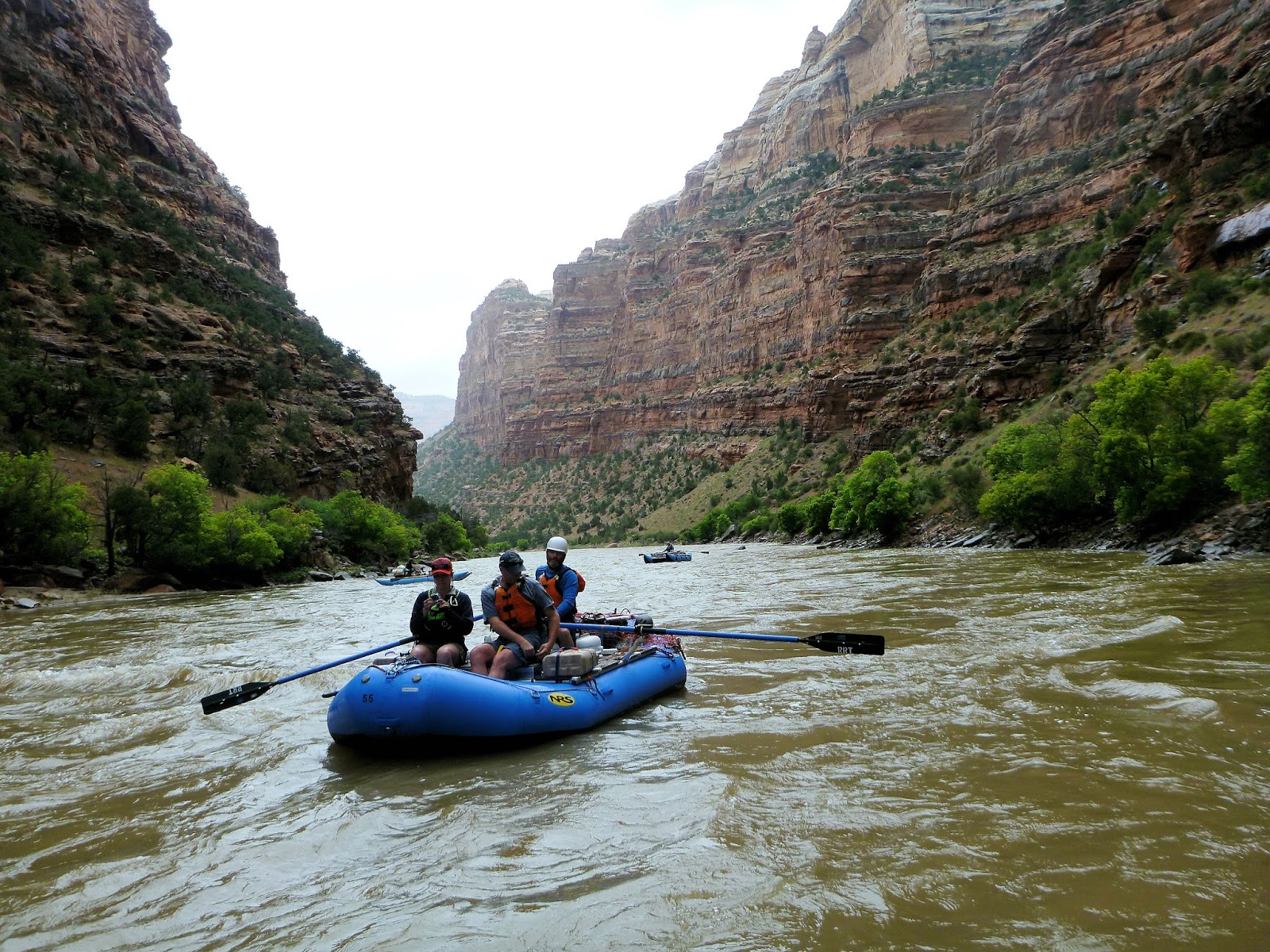
The trip began at Deerlodge Park. From this point, we floated on the Yampa for 46 miles to Echo Park where it joins the Green River. The notable rapids included Teepee Rapid (III), Big Joe Rapid (III) and Warm Springs Rapid (IV).


The Yampa meanders through the Yampa Canyon, with spectacular tilted beds of sandstone. Smooth canyon walls overhang the river in some places towering up to 1,000 feet above the water. We had some rainy weather the first day with a 20 mile float to the first campsite, Big Joe. The weather cleared the next morning giving us the opportunity to explore the area. There were some beautiful rock formations near this campsite a short distance up a small gorge.

Big Joe Campsite

Rock Formations near Big Joe Campsite

The name Yampa is derived from the Snake Indians word for the Perideridia plant --  a tall, grass-like plant in the Parsley family. Yampah was a major food plant of the Native Americans, who would collect its root, dry it, and pound it into a white meal. John C. Frémont recorded the name 'Yampah' in entries of his journal from 1843 (Report of the exploring expedition to the Rocky Mountains in the year 1842 : and to Oregon and north California in the years 1843-44 by Frémont, John Charles, 1813-1890; Torrey, John, 1796-1873; Hall, James, 1811-1898; United States Army Corps of Engineers, Published 1845):
"It grows more abundantly, and in greater luxuriance, on one of the neighboring tributaries of the Colorado than in any other part of this region; and on that stream, to which the Snakes are accustomed to resort every year to procure a supply of their favorite plant, they have bestowed the name of Yampah river."
The second day was a bit rainy again, but short. We stopped to check out a cave known as Signature Cave. There was a lot of graffiti inside the cave made by river runners from the 1930s and 1940s.


Traveling between Big Joe and Mathers Hole Campsites

View from inside Signature Cave

Mathers Hole campsite was beneath a large overhung cliff that is about 500 feet tall. The area beneath the overhang was sheltered from rain and very sandy -- perfect for horseshoes.


A game of horseshoes beneath Mathers Hole overhang

There were additional opportunities for hiking at Mathers Hole. One of the trails led to the top of the canyon for an incredible view of the river below.


View of Yampa River near Mathers Hole campsite

We spotted several types of birds and signs of beavers. The Yampa River is important spawning habitat for the endangered Razorback sucker (Xyrauchen texanus) and Colorado pikeminnow (Ptychocheilus lucius), the largest minnow in North America, which historically reached lengths of 6 feet. Today they typcially reach lengths of 2-3 feet. Other endangered species in the Yampa River include humpback chub (Gila cypha) and bonytail (Gila elegans)  Eighteen non-native fish species have been introduced some of which include channel catfish, common carp, green sunfish, northern pike, red shiner.

The weather cleared on day three from Mathers Hole campsite to Laddie Park campsite. While it was another short day, the scenery was amazing. Photographs do not come close to capturing the spectacular canyon walls, such as the Grand Overhang and Tiger Wall (actually on day 4 between Laddie Park and Sea Cliff Beach campsites).


Grand Overhang

Tiger Wall

En route to Sea Cliff Beach campsite, we arrived at Warm Springs Rapid, the only class IV on this trip. Apparently the rapid was created in 1965 by a flash flood that washed a debris flow down Warm springs Draw. There is a 1,500 foot cliff here, the tallest on the trip, but most folks were focused on the rapid. The main hazard here is Maytag Hole which can flip boats. Not being a fan of class IVs, I was the only person who chose to walk, but all bodies and boats made it through with no trouble.

A film was released by Friends of the Yampa in November 2014 about the Yampa River and formation of the Warm Springs Rapid. Check it out ONLINE.

Shortly before reaching Sea Cliff Beach, we reached the confluence of the Yampa and Green Rivers.

Confluence of the Yampa and Green Rivers

Christi enjoying the scenery with "Wilson"

The next day, we traveled between Sea Cliff Beach campsite and Jones Hole campsite. Near Jones Hole Creek, there were several trails to hike, one of which led to some 1,000 year-old pictographs created by the Fremont people.

Pictographs by the Fremont People

Checking out the pictographs

There was also a waterfall, which we all found to be entertaining (and refreshing after camping for several days)... and bunnies too!

Karen's turn!

A bunny on the trail

Our last night of camping was at Island Park, near "Bug Island".... eh em... I mean Big Island. There were soooo many mosquitos! Everyone dealt with it in good spirits.

Overall it was an amazing trip and a wonderful group. I didn't take many photos on the water, but I'll end with a small clip taken towards the end of the trip. The flow during the trip was between 7,500 and 8,000 cfs, which seemed just great. Because its natural flooding process is essentially undisturbed, this is definitely a precious natural resource to be protected. I feel so lucky to have had the opportunity to have this experience.


5/16/2015

John Day River -- Service Creek to Clarno

John Day River Trip -- Service Creek to Clarno

The John Day River in northeastern Oregon from Service Creek to Clarno Launch is an excellent choice for beginning whitewater rafters. This section is a 48 mile trip that can be completed in 3 days, with only three Class II rapids and one Class II/III. Overall, it is a slow moving river perfect for its scenery, wildlife viewing, and fishing, however, the rapids should not be underestimated, particularly in higher flows. We put in at Service creek in May at a barely runnable flow (around 1,000 cfs). Another (downstream) section from Clarno to Cottonwood contains Class II-IV rapids (Clarno Rapid III-IV) and can be floated in around 7 days.

From Service Creek to Clarno Launch you can expect to float through a substantial amount of disturbed ranch land. However, there are sections with spectacular scenery, particularly in the early morning or late afternoon. Geologic features include colorful painted hills of the Morrison formation, basalt cliffs, and formations from ancient pyroclastic flows.

Basalt Cliffs
The John Day River is the second longest free-flowing river in the contiguous United States, after the Yellowstone River, and the water levels can vary widely depending on the snow pack of the Blue Mountains. Starting at its headwaters in the Strawberry Mountain range, the river flows 281 miles to the Columbia River. You can expect to see a variety of raptors and songbirds. Bald eagles, herons, killdeers, Canada geese, western tanagers are a few of the species we spotted. Bank Swallows nest in huge colonies in cliffs along the river. The video below has footage from one well-used hillside:


The river was named for American hunter, John Day, a member of Wilson Price Hunt's Astoria overland fur trapping expedition of 1811 and 1812. There was evidence of beaver dams all along this section of the river which also provides habitat for many endangered fish species, including wild steelhead, Chinook salmon, and bull trout. The Confederated Tribes of Warm Springs own the Pine Creek Conservation Area at river mile 129, which is managed for wildlife and fish habitat.

Upland view of the John Day River
The Oregon Natural Desert Association is working to obtain wilderness designations for more than 130,000 acres of the river corridor and upland fish and wildlife habitat. This would include a Cathedral Rock Conservation Area of 17,000 acres.

Approaching Cathedral Rock
More volcanic formations
There are many campsites along the river for both groups and individuals. At the time we were there, few boaters were on the river and we had the place mostly to ourselves.

The most notable rapid between Service Creek and Clarno Launch is Burnt Ranch Rapids, which is about 11.5 miles downstream of the Twickenham boat launch and the last rapid you will encounter on this section. In low water, it is a bit rocky and drift boats can grab the rocks.


Overall, this is a relaxing trip and a nice opportunity to see some beautiful landscapes in northeastern Oregon. While we didn't do any hiking, there many places on BLM land to explore.